
For some time, I have been thinking about what happens to wildlife when human spaces expand.
I live and work in regional Victoria, and since moving to Creswick in 2009 I have watched towns grow, new housing developments appear, and landscapes that once sat at the edges of communities become increasingly occupied by us. These changes are often discussed in terms of human need—where we will live, how communities will grow, what infrastructure we require. All of those questions matter.
But I keep wondering about the inhabitants who were already there.
Where do they go when we arrive?
It started with a deer in a bath
Domestic Animals began, although I didn’t know it at the time, with a painting called How’s the Water, Dear?
In the painting, a deer is lying in an old claw-foot bath. He isn’t frightened or trapped. He isn’t behaving like a wild animal that has accidentally wandered into someone’s bathroom.
He is completely at home.
I was interested in what happened when I reversed a familiar relationship.
We are accustomed to wildlife entering our spaces. A bird flies into the house. A possum moves into the roof. Kangaroos appear on a golf course or suburban lawn. We describe them as displaced, troublesome, invasive or simply out of place.
But what if the animals weren’t out of place?
What if we were?
Once I started showing it, I was touched to see the responses. Children tended to immediately accept the absurdity of a deer having a bath while finding it hilarious and somewhat naughty and absurd, while adults often lingered and began wondering about the story behind it. Sometimes literally asking “What made you think of that?”
Making themselves at home
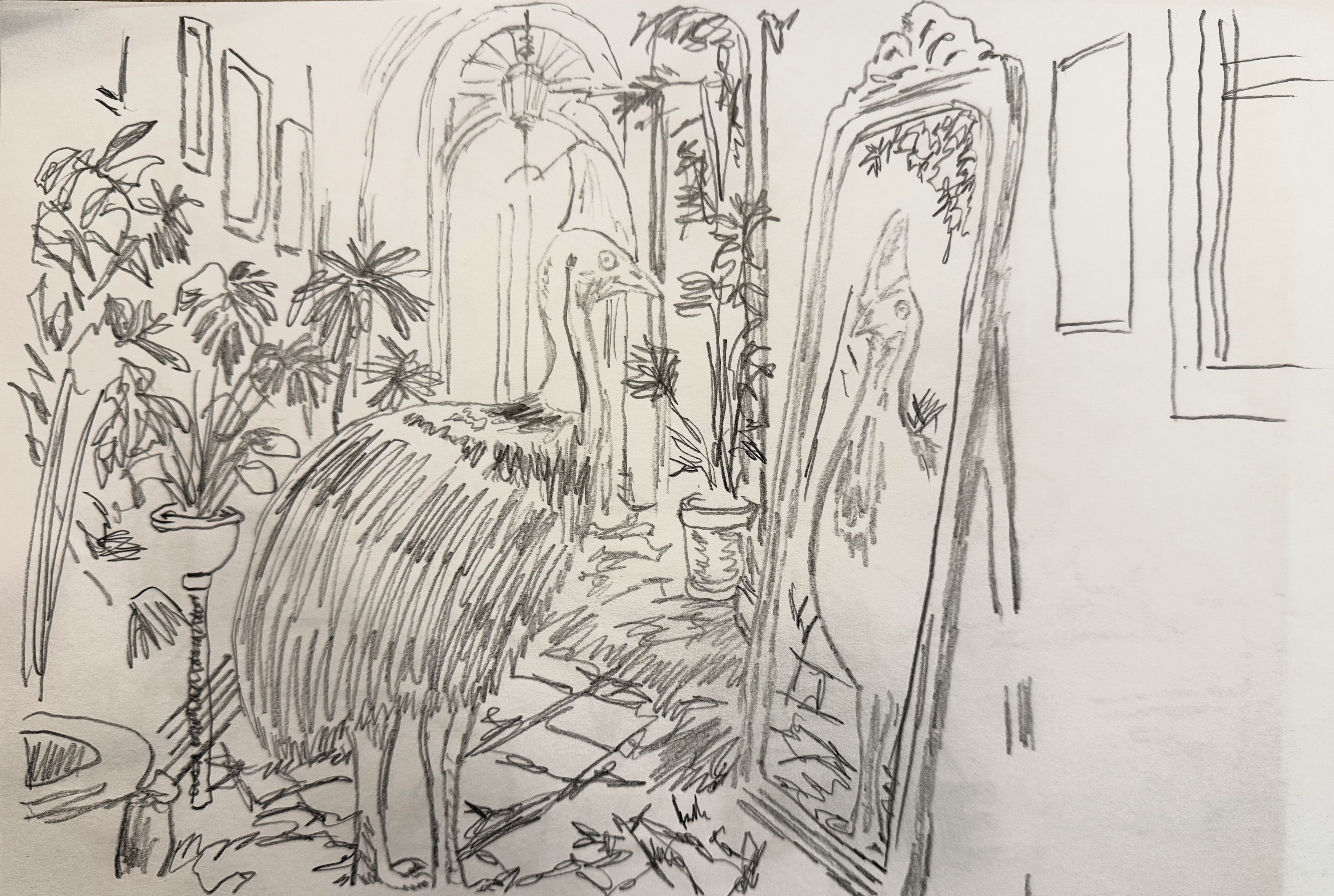
That question has grown into Domestic Animals, a proposed body of twelve large-scale narrative oil paintings exploring habitat, belonging and human–wildlife coexistence.
Across the series, Australian animals will occupy familiar domestic environments.
A wombat sleeping on a velvet sofa beside a fireplace, a place usually reserved for a pet. A heron fishes from a laundry trough. Wedge-tailed eagles gather around a dining table. Flying foxes hang among coats. An echidna follows a trail of ants across a kitchen bench.
The animals aren’t anthropomorphised. They don’t wear clothes, pour cups of tea or behave like little humans.
They remain completely themselves.
It is the human environment around them that has shifted.
That distinction has become increasingly important to me as the project develops. I don’t want the paintings to be illustrations of animals pretending to be people. I want them to feel as though the animals have simply accepted these strange constructed environments as part of their habitat and adapted accordingly.
There is whimsy in that idea, and beauty, and sometimes gentle absurdity. But beneath it sits a more serious question about the landscapes we share.
Where my practice is heading
Animals and the natural world have appeared in my paintings for some time, often in imagined or altered environments. Increasingly, I’ve realised that I’m interested not simply in environmental change itself, but in environmental belonging.
Who belongs to a landscape?
Who decides?
And what happens when the needs of one species continually reshape the world available to another? We’re not the only one’s who notice our towns and cities expanding at increasingly alarming rates.
I’m interested in whether painting can approach those questions without becoming didactic. I don’t particularly want to tell people what they should think. I’m much more interested in making an image that causes someone to stop, perhaps smile at first, and then notice that something underneath the image has begun to shift.
For Domestic Animals, I’m researching human–wildlife coexistence, environmental humanities, ecological belonging and the ways narrative and empathy can influence how we understand non-human lives. That research won’t be illustrated directly in the paintings. Instead, I hope it will sit quietly underneath them, informing the questions I ask and the choices I make.
This project also represents a change in scale for me.
Rather than creating individual narrative paintings that exist independently, I want to explore what happens when I allow one idea enough space to become an entire body of work. Twelve large paintings will let characters, environments and questions speak to one another across an exhibition.
It feels like the next step in my practice.
Where I hope it goes
Domestic Animals is currently in development, with research, drawings and compositional studies underway. I plan to develop the paintings across 2027–28, working towards a professional public exhibition.
I’m beginning conversations with galleries and organisations whose programs connect with contemporary art, environmental ideas and our relationship with the natural world. I’m also continuing to sketch, research and allow individual paintings to change as the larger body of work finds its shape.
I don’t know yet exactly what the finished exhibition will feel like.
I think that’s important.
There needs to be enough room in a project like this for discovery—for a painting to resist the original plan, for research to lead somewhere unexpected, or for one animal quietly sitting somewhere it supposedly shouldn’t be to change the direction of everything that follows.
What I do know is that I want Domestic Animals to create an encounter rather than deliver a lesson.
Perhaps someone will walk into the exhibition and first see the improbable sight of wildlife comfortably inhabiting our homes.
Perhaps they’ll smile.
And perhaps, somewhere between the wombat on the sofa and the eagles at the dining table, the distinction between our space and their space will become a little less certain.
Because ultimately, Domestic Animals keeps bringing me back to one deceptively simple question:
Who gets to feel at home?






Recent Comments